
Proportion is the one thing street style guides almost never explain directly. They show you the outfit, they name the brands, they tell you to “balance” things without saying what balance actually means in practice. After years of getting dressed in ways that looked off in photos even when each piece seemed fine on its own, the fix came down to a single ratio: the visual break between top and bottom should land at roughly one-third of the body’s total height, not the midpoint.
Call it the 1:2 split. One part above the break, two parts below, or the reverse. What it rules out is the 1:1 cut, where the hem of a top or jacket bisects the body exactly at the waist or hip and creates two equal halves. Equal halves, on most silhouettes, just look static. The eye has nowhere to travel.
What “The Break” Actually Means
The break is wherever the eye reads a horizontal line across the body. A hem is the obvious one, but so is the hem of an untucked shirt hitting the top of the thigh, the bottom of a cropped jacket sitting above the hip bone, or even where a differently colored top ends against dark pants. Anywhere contrast or edge creates a visual seam, that is a break, and its vertical placement determines whether the outfit reads as deliberate or accidental.
Waist-length pieces land the break near the true waist, which sits high on the torso. The result is a long lower-body portion and a short upper one: that 1:2 or 1:3 ratio. Hip-length pieces drop the break to around the widest part of the hips, which for most people is still comfortably above the midpoint of the total height from crown to floor. A standard tee that ends just below the belt is the piece that causes the most trouble, because it splits the figure almost exactly in half and makes the legs look shorter than they are.
The Cropped Jacket Problem
Cropped jackets became one of the dominant outerwear shapes over the last few years, and the complaints about them almost always come from people who are wearing them wrong relative to their pants. A cropped jacket works because it puts the break high, exposing a long uninterrupted run of leg. That is the whole logic of the shape. When the same jacket goes over wide-leg trousers with a high rise, the long trouser leg below and the short jacket above create a very clean 1:2 or 1:3 line. When the same jacket goes over slim jeans with a mid-rise, the break lands at roughly the same absolute height, but the anklecuff and a bit of shoe get seen at the bottom of a very long undivided leg, so it still mostly works.
Where it falls apart is over a standard mid-length shirt that hangs out underneath. Now there are two horizontal breaks, one from the jacket hem and one from the shirt hem, and they are close together but not at the same height. The eye bounces between them. The rule breaks down whenever two competing breaks appear within a few inches of each other, because the body reads both lines simultaneously and the ratio becomes unclear.
Oversized Tops and Where They Actually End
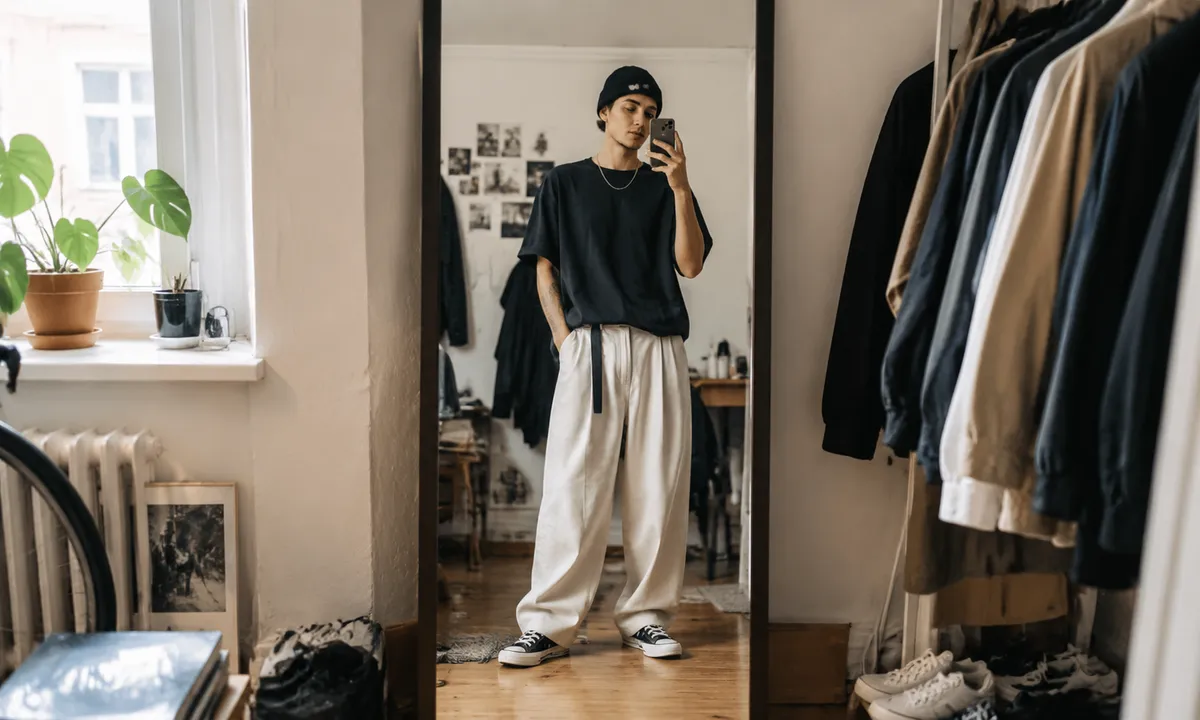
Oversized and boxy tops are the piece where the 1:2 rule is most frequently misapplied, because people try to wear them the same way they wear fitted tops and the hem ends up in completely different territory. A slim fitted tee on an average frame might end at three inches below the waistband. The same top in an oversized fit might end eight or ten inches lower, putting the break squarely in the mid-thigh zone. That is almost always the 1:1 split, right through the visual midpoint of the body.
The fixes are direct. One: tuck the front half of the oversized top into the waistband, a half-tuck, so the visual break moves back up toward the waist. The back stays long and relaxed, the front defines the waist, and the proportion reads correctly. Two: wear the oversized top with trousers that are high-rise enough that their waistband rises above the hem of the shirt. The trouser covers the shirt hem entirely, making the pants the top of the lower portion and eliminating the competing break. Three: lean into it and wear the oversized top as the top layer over fitted shorts or tapered pants, where the shirt ends mid-thigh and the narrow leg below creates the long lower portion. The break is still at mid-thigh, but with slim legs beneath it, the proportion holds.
How Footwear Moves the Break Without Changing the Clothes
Shoes are underrated as a proportion tool. They extend or terminate the visible leg line, which effectively shifts where the overall 1:2 ratio lands. Chunky sneakers with a tall midsole add visual mass at the ankle and read as a heavy horizontal base. They can actually pull the eye down and make a mid-body break look lower than it is. Clean, low-profile shoes do the opposite: they let the leg line extend to the floor uninterrupted, which makes the lower portion of the body read as longer and restores a proportion that might have been borderline.
This is why the same outfit can look proportionally different on the same person in different shoes. A pair of straight-leg pants with a cropped jacket looks sharp in a low cup-sole sneaker. The same outfit in a thick-soled dad shoe looks squat, because the chunky shoe adds a third visual element at the base and interrupts what should be a clean lower line. The rule has to account for the full vertical run, crown to floor, not just the clothes on the torso.
The One Case Where 1:1 Works
Matching sets. When a top and bottom are the same fabric, the same color, and close in weight and texture, the break between them becomes invisible. The eye reads the whole outfit as one unbroken unit rather than two equal halves, because there is no contrast at the seam line. This is the only reliable exception to the rule: if the break cannot be seen, its placement does not matter. A sand linen shirt over sand linen wide-leg trousers, both pieces the same shade, can fall exactly at the natural waist (the 1:1 split in literal measurement) and still look long and unified rather than chopped.
Tonal dressing in general softens breaks. A navy tee over navy pants does not disappear the break the way a true set does, but the lower contrast reduces its visual weight and makes the exact placement matter less. The trouble comes when people take the tonal outfit and add a belt or a different-colored overshirt, which suddenly reintroduces sharp contrast right at the waistline and brings the break back into play.
Layering Without Stacking Breaks
Layering is where proportion rules get complicated fast, because every added piece has a hem and every hem is a potential break. The discipline is to either align breaks so they land at the same height (making them read as one line) or separate them far enough apart that they create their own clear zones. The middle ground, where two hems hover two or three inches apart, is the zone to avoid. It creates visual noise with no structural logic.
A long tee under an open shirt works because the tee hem and the shirt hem are usually close enough in length that they merge, or the open shirt is worn open so its hem hangs alongside the tee and the eye sees them as parallel rather than competing. A tee under a bomber with a few inches of tee poking out below is a separate kind of layering: the bomber creates the primary break and the tee extends slightly beyond it, which can look intentional or sloppy depending on exactly how much tee is visible. An inch or two reads as a proportion choice. Six inches reads as the wrong size bomber.
Reading the Ratio in the Mirror
The practical version of this is simple to apply. Stand in front of a full-length mirror and find where the dominant horizontal break sits on the outfit. Cover the bottom third of the mirror with a hand. If the break is in the top third of what is visible, the ratio is probably right. If the break falls in the exact center of the full height, the outfit is splitting at the midpoint and the legs will look shorter than they are in the actual world. Adjust the hem, tuck the front, or swap in a different outer layer until the break moves up into the upper third.
It takes about thirty seconds once the habit is there. And it is a more honest diagnostic than Instagram photos, which are taken from angles and with focal lengths that distort proportion significantly. A photo shot from below with a wide lens will make any leg look long. The mirror, straight on, at eye level, shows the actual ratio.
Shorts, and Why They Are Harder Than They Look
Shorts are a specific case worth addressing directly because the break functions differently. The hem of the shorts creates the bottom of the upper-body zone, but the leg below is exposed and has its own visible length. A very long shirt over shorts can move the break to mid-thigh while the bare leg continues to the knee and below. This can work, but it tends to make the shorts invisible, which raises the question of why the shorts are there at all rather than pants.
The fits that work cleanest with shorts are ones where the top ends above the shorts waistband (full tuck or cropped), putting the break at the actual waist and letting the whole leg read as one long lower portion from hip to knee to shin. Mid-thigh shorts with a tucked tee create a genuinely long visible leg relative to the total height of the outfit, which is exactly what the 1:2 rule is trying to produce. The version that consistently goes wrong is the untucked tee of standard length over mid-thigh shorts, where the tee hem and the shorts hem compete within a few inches of each other while both also hover right around the mid-body line.