


The Bleed Between Them
The categories have been bleeding into each other for roughly two decades, and that process has accelerated considerably. Luxury houses started takingcues from streetwear in the mid-2010s, borrowing the silhouettes and the drop model and the collaborative logic. Streetwear, in response, absorbed some of the material quality and finish work associated with tailoring and premium casualwear. The result is a market where the distinction between categories is harder to read from the garment alone.
This convergence has produced a genuinely new middle ground that is neither pure casualwear nor traditional street style. Call it elevated basics, or quiet streetwear, or whatever the current vocabulary settles on. A heavyweight double-faced hoodie in a muted earthy tone, worn with wide-leg trousers in a complementary shade and leather sneakers with a clean profile: this outfit carries streetwear DNA in its proportional awareness and its material seriousness, but it operates at the volume of casualwear. It is not demanding anything of the room, but it was clearly thought about.
That middle space is where a lot of the more interesting dressing is happening right now, and it did not exist as a recognized category a generation ago.
When the Line Actually Matters
For most people getting dressed most mornings, the line between street style and casualwear does not need to be exactly located. What matters is understanding which register a specific outfit is operating in, so that the internal logic of the outfit holds together. Mixing pieces from both categories only works if the mix is the point, and if the pieces are chosen with enough care that the combination reads as a decision rather than an accident.
The specific failure mode to avoid is assembling an outfit where some pieces are asking for attention and others are refusing it. A technically excellent streetwear jacket paired with completely inert casualwear pieces below the waist reads as someone who gave up halfway. The jacket sits on top of the outfit rather than inside it. The whole thing looks less finished than either category would have looked on its own.
Consistency of intention is the rule. Decide which logic the outfit is operating under, dress everything to that logic, and the line between the two categories will resolve itself in the wearing. The jacket, the trousers, the shoes: when all three are answering the same question, the question of which category the outfit belongs to stops being interesting, because the outfit is already working.
Branding, Graphics, and the Question of References
Casualwear typically holds branding to a minimum or deploys it discreetly. A small logo on a chest pocket, an embroidered wordmark near the hem. The assumption is that the wearer is not interested in broadcasting affiliations. Street style, by contrast, has a complicated but long-standing relationship with visible branding. The outsized logo, the vintage band tee, the collaboration graphic: these are not decorations, they are references. They signal that the wearer knows something, is part of something, or has access to something.
The trouble starts when the reference is adopted without the fluency. A Supreme box logo on a pullover worn with khaki cargo shorts and trail runners is not street style, whatever the retail price of the top. The reference is floating loose in an outfit that has no logic connecting it to the piece. Street style requires that pieces talk to each other, even when the conversation is deliberately strange or confrontational.
Graphics in casualwear function as personality notes, not arguments. The difference in purpose is part of what makes the garment land differently even when it is objectively the same object.
The Bleed Between Them
The categories have been bleeding into each other for roughly two decades, and that process has accelerated considerably. Luxury houses started takingcues from streetwear in the mid-2010s, borrowing the silhouettes and the drop model and the collaborative logic. Streetwear, in response, absorbed some of the material quality and finish work associated with tailoring and premium casualwear. The result is a market where the distinction between categories is harder to read from the garment alone.
This convergence has produced a genuinely new middle ground that is neither pure casualwear nor traditional street style. Call it elevated basics, or quiet streetwear, or whatever the current vocabulary settles on. A heavyweight double-faced hoodie in a muted earthy tone, worn with wide-leg trousers in a complementary shade and leather sneakers with a clean profile: this outfit carries streetwear DNA in its proportional awareness and its material seriousness, but it operates at the volume of casualwear. It is not demanding anything of the room, but it was clearly thought about.
That middle space is where a lot of the more interesting dressing is happening right now, and it did not exist as a recognized category a generation ago.
When the Line Actually Matters
For most people getting dressed most mornings, the line between street style and casualwear does not need to be exactly located. What matters is understanding which register a specific outfit is operating in, so that the internal logic of the outfit holds together. Mixing pieces from both categories only works if the mix is the point, and if the pieces are chosen with enough care that the combination reads as a decision rather than an accident.
The specific failure mode to avoid is assembling an outfit where some pieces are asking for attention and others are refusing it. A technically excellent streetwear jacket paired with completely inert casualwear pieces below the waist reads as someone who gave up halfway. The jacket sits on top of the outfit rather than inside it. The whole thing looks less finished than either category would have looked on its own.
Consistency of intention is the rule. Decide which logic the outfit is operating under, dress everything to that logic, and the line between the two categories will resolve itself in the wearing. The jacket, the trousers, the shoes: when all three are answering the same question, the question of which category the outfit belongs to stops being interesting, because the outfit is already working.
The Silhouette Argument
If there is one technical place where street style and casualwear diverge most visibly, it is silhouette. Casualwear works in a relatively narrow range of fits: clothes that skim the body without exaggerating any feature. Street style has always been willing to play the extremes. Extreme oversize. Extreme crop. Extreme taper. Very wide leg against a very fitted top. The contrast between volumes is the whole point.
This is why the same garment can function in both registers depending on how it is sized. A large-fit tee worn with slim pants and clean sneakers can read as casual if the proportions are accidental, but can read as street style if the tee is large enough to create a deliberate silhouette contrast, the pants end with intention, and the shoes close the thought. The clothes are nearly identical. The architecture is different.
Casualwear tends to dress the body. Street style tends to build around it.
Branding, Graphics, and the Question of References
Casualwear typically holds branding to a minimum or deploys it discreetly. A small logo on a chest pocket, an embroidered wordmark near the hem. The assumption is that the wearer is not interested in broadcasting affiliations. Street style, by contrast, has a complicated but long-standing relationship with visible branding. The outsized logo, the vintage band tee, the collaboration graphic: these are not decorations, they are references. They signal that the wearer knows something, is part of something, or has access to something.
The trouble starts when the reference is adopted without the fluency. A Supreme box logo on a pullover worn with khaki cargo shorts and trail runners is not street style, whatever the retail price of the top. The reference is floating loose in an outfit that has no logic connecting it to the piece. Street style requires that pieces talk to each other, even when the conversation is deliberately strange or confrontational.
Graphics in casualwear function as personality notes, not arguments. The difference in purpose is part of what makes the garment land differently even when it is objectively the same object.
The Bleed Between Them
The categories have been bleeding into each other for roughly two decades, and that process has accelerated considerably. Luxury houses started takingcues from streetwear in the mid-2010s, borrowing the silhouettes and the drop model and the collaborative logic. Streetwear, in response, absorbed some of the material quality and finish work associated with tailoring and premium casualwear. The result is a market where the distinction between categories is harder to read from the garment alone.
This convergence has produced a genuinely new middle ground that is neither pure casualwear nor traditional street style. Call it elevated basics, or quiet streetwear, or whatever the current vocabulary settles on. A heavyweight double-faced hoodie in a muted earthy tone, worn with wide-leg trousers in a complementary shade and leather sneakers with a clean profile: this outfit carries streetwear DNA in its proportional awareness and its material seriousness, but it operates at the volume of casualwear. It is not demanding anything of the room, but it was clearly thought about.
That middle space is where a lot of the more interesting dressing is happening right now, and it did not exist as a recognized category a generation ago.
When the Line Actually Matters
For most people getting dressed most mornings, the line between street style and casualwear does not need to be exactly located. What matters is understanding which register a specific outfit is operating in, so that the internal logic of the outfit holds together. Mixing pieces from both categories only works if the mix is the point, and if the pieces are chosen with enough care that the combination reads as a decision rather than an accident.
The specific failure mode to avoid is assembling an outfit where some pieces are asking for attention and others are refusing it. A technically excellent streetwear jacket paired with completely inert casualwear pieces below the waist reads as someone who gave up halfway. The jacket sits on top of the outfit rather than inside it. The whole thing looks less finished than either category would have looked on its own.
Consistency of intention is the rule. Decide which logic the outfit is operating under, dress everything to that logic, and the line between the two categories will resolve itself in the wearing. The jacket, the trousers, the shoes: when all three are answering the same question, the question of which category the outfit belongs to stops being interesting, because the outfit is already working.
What Casualwear Actually Gets Right
It would be a mistake to treat casualwear as the lesser category. It is doing a different job and doing it well. The whole point of a well-designed casual wardrobe is that it disappears. A good-fitting Oxford shirt, dark jeans without hardware or heavy distressing, clean leather sneakers or loafers: this combination navigates most of daily life without friction. It respects other people in a room by not demanding that they look at you. In many professional and social contexts, that kind of visual restraint is exactly right.
Casualwear also ages more slowly than street style. A cardigan from fifteen years ago is still a cardigan. A graphic hoodie from a specific drop in a specific season is already dated in ways that require insider knowledge to fully appreciate. For anyone who is not actively following the conversation, it can register as noise.
That durability matters more than it sounds. Building a casualwear foundation means investing in things that will outlast a trend cycle. Street style pieces, even good ones, often carry an expiration date embedded in their references.
The Silhouette Argument
If there is one technical place where street style and casualwear diverge most visibly, it is silhouette. Casualwear works in a relatively narrow range of fits: clothes that skim the body without exaggerating any feature. Street style has always been willing to play the extremes. Extreme oversize. Extreme crop. Extreme taper. Very wide leg against a very fitted top. The contrast between volumes is the whole point.
This is why the same garment can function in both registers depending on how it is sized. A large-fit tee worn with slim pants and clean sneakers can read as casual if the proportions are accidental, but can read as street style if the tee is large enough to create a deliberate silhouette contrast, the pants end with intention, and the shoes close the thought. The clothes are nearly identical. The architecture is different.
Casualwear tends to dress the body. Street style tends to build around it.
Branding, Graphics, and the Question of References
Casualwear typically holds branding to a minimum or deploys it discreetly. A small logo on a chest pocket, an embroidered wordmark near the hem. The assumption is that the wearer is not interested in broadcasting affiliations. Street style, by contrast, has a complicated but long-standing relationship with visible branding. The outsized logo, the vintage band tee, the collaboration graphic: these are not decorations, they are references. They signal that the wearer knows something, is part of something, or has access to something.
The trouble starts when the reference is adopted without the fluency. A Supreme box logo on a pullover worn with khaki cargo shorts and trail runners is not street style, whatever the retail price of the top. The reference is floating loose in an outfit that has no logic connecting it to the piece. Street style requires that pieces talk to each other, even when the conversation is deliberately strange or confrontational.
Graphics in casualwear function as personality notes, not arguments. The difference in purpose is part of what makes the garment land differently even when it is objectively the same object.
The Bleed Between Them
The categories have been bleeding into each other for roughly two decades, and that process has accelerated considerably. Luxury houses started takingcues from streetwear in the mid-2010s, borrowing the silhouettes and the drop model and the collaborative logic. Streetwear, in response, absorbed some of the material quality and finish work associated with tailoring and premium casualwear. The result is a market where the distinction between categories is harder to read from the garment alone.
This convergence has produced a genuinely new middle ground that is neither pure casualwear nor traditional street style. Call it elevated basics, or quiet streetwear, or whatever the current vocabulary settles on. A heavyweight double-faced hoodie in a muted earthy tone, worn with wide-leg trousers in a complementary shade and leather sneakers with a clean profile: this outfit carries streetwear DNA in its proportional awareness and its material seriousness, but it operates at the volume of casualwear. It is not demanding anything of the room, but it was clearly thought about.
That middle space is where a lot of the more interesting dressing is happening right now, and it did not exist as a recognized category a generation ago.
When the Line Actually Matters
For most people getting dressed most mornings, the line between street style and casualwear does not need to be exactly located. What matters is understanding which register a specific outfit is operating in, so that the internal logic of the outfit holds together. Mixing pieces from both categories only works if the mix is the point, and if the pieces are chosen with enough care that the combination reads as a decision rather than an accident.
The specific failure mode to avoid is assembling an outfit where some pieces are asking for attention and others are refusing it. A technically excellent streetwear jacket paired with completely inert casualwear pieces below the waist reads as someone who gave up halfway. The jacket sits on top of the outfit rather than inside it. The whole thing looks less finished than either category would have looked on its own.
Consistency of intention is the rule. Decide which logic the outfit is operating under, dress everything to that logic, and the line between the two categories will resolve itself in the wearing. The jacket, the trousers, the shoes: when all three are answering the same question, the question of which category the outfit belongs to stops being interesting, because the outfit is already working.
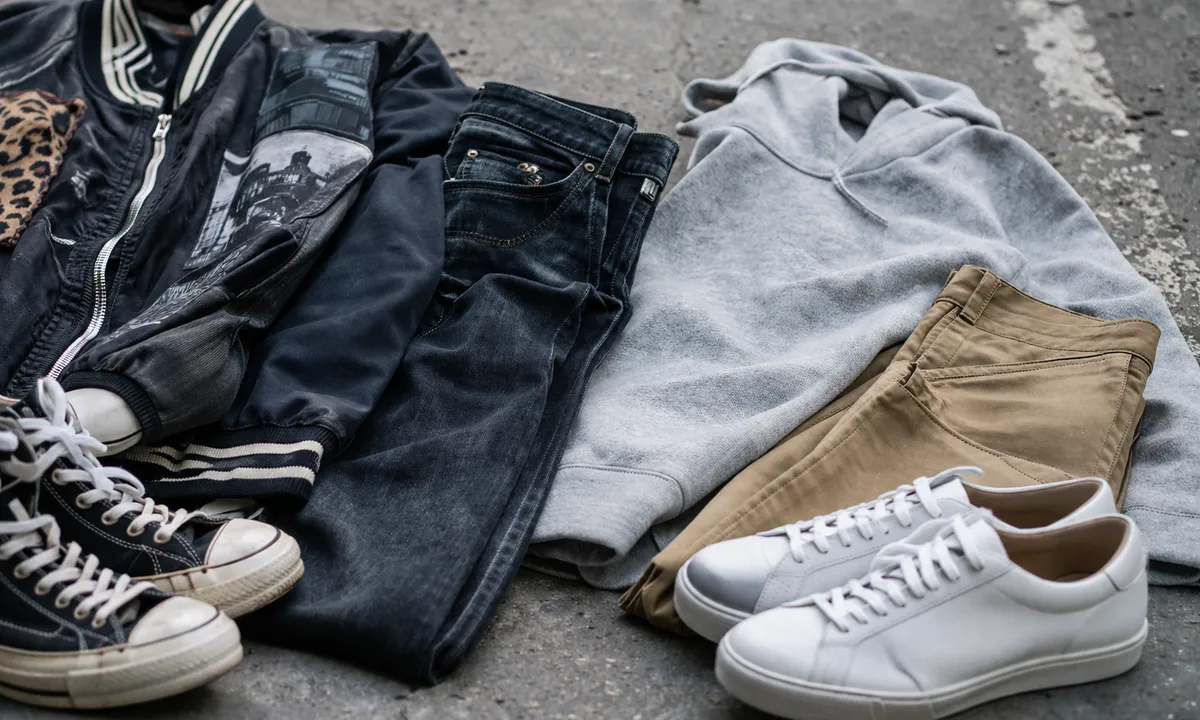
Street style and casualwear share a wardrobe, mostly. The same jeans can do both. The same sneakers. Sometimes the same jacket. And yet anyone who has spent time around both worlds knows immediately when someone has crossed from one into the other. The distinction is real, even if it resists a clean definition.
Casualwear is clothing chosen for comfort and low friction. It asks nothing of the wearer beyond basic presentability. A pullover hoodie in a neutral color, chinos that fit without demanding attention, white leather sneakers kept clean enough. The logic is subtraction: remove whatever would cause effort, cost, or comment. It is dressing as a solved problem.
Street style is something else entirely. It is dressing as a position.
Intention Is the Dividing Line
The single clearest way to separate the two categories is this: casualwear happens when someone gets dressed; street style happens when someone decides what to wear. The gap between those two actions sounds philosophical, but it shows up in the clothes themselves. Street style is proportionally conscious. The oversized bomber is not oversized by accident. The cropped length on the trousers, the deliberate gap between hem and sock, the color of the sock against the shoe: these are choices, stacked. Casualwear tolerates proportions. Street style obsesses over them.
This is partly why the category emerged from subcultural spaces rather than from department stores. Skateboarding, hip-hop, basketball, grime, harajuku crowds: these were communities where what you wore was a form of membership and, often, a form of argument. Wearing something off-model or from a brand nobody else had found yet carried real social meaning. The intentionality was built into the culture before it was ever formalized as a fashion category.
When that intentionality travels into a mainstream wardrobe without the underlying investment, the result is a costume. Expensive streetwear worn with casualwear energy reads as casualwear. The reverse happens too: someone assembles a genuinely considered outfit from inexpensive basics and reads as street style, because the thinking is legible in the choices.
What Casualwear Actually Gets Right
It would be a mistake to treat casualwear as the lesser category. It is doing a different job and doing it well. The whole point of a well-designed casual wardrobe is that it disappears. A good-fitting Oxford shirt, dark jeans without hardware or heavy distressing, clean leather sneakers or loafers: this combination navigates most of daily life without friction. It respects other people in a room by not demanding that they look at you. In many professional and social contexts, that kind of visual restraint is exactly right.
Casualwear also ages more slowly than street style. A cardigan from fifteen years ago is still a cardigan. A graphic hoodie from a specific drop in a specific season is already dated in ways that require insider knowledge to fully appreciate. For anyone who is not actively following the conversation, it can register as noise.
That durability matters more than it sounds. Building a casualwear foundation means investing in things that will outlast a trend cycle. Street style pieces, even good ones, often carry an expiration date embedded in their references.
The Silhouette Argument
If there is one technical place where street style and casualwear diverge most visibly, it is silhouette. Casualwear works in a relatively narrow range of fits: clothes that skim the body without exaggerating any feature. Street style has always been willing to play the extremes. Extreme oversize. Extreme crop. Extreme taper. Very wide leg against a very fitted top. The contrast between volumes is the whole point.
This is why the same garment can function in both registers depending on how it is sized. A large-fit tee worn with slim pants and clean sneakers can read as casual if the proportions are accidental, but can read as street style if the tee is large enough to create a deliberate silhouette contrast, the pants end with intention, and the shoes close the thought. The clothes are nearly identical. The architecture is different.
Casualwear tends to dress the body. Street style tends to build around it.
Branding, Graphics, and the Question of References
Casualwear typically holds branding to a minimum or deploys it discreetly. A small logo on a chest pocket, an embroidered wordmark near the hem. The assumption is that the wearer is not interested in broadcasting affiliations. Street style, by contrast, has a complicated but long-standing relationship with visible branding. The outsized logo, the vintage band tee, the collaboration graphic: these are not decorations, they are references. They signal that the wearer knows something, is part of something, or has access to something.
The trouble starts when the reference is adopted without the fluency. A Supreme box logo on a pullover worn with khaki cargo shorts and trail runners is not street style, whatever the retail price of the top. The reference is floating loose in an outfit that has no logic connecting it to the piece. Street style requires that pieces talk to each other, even when the conversation is deliberately strange or confrontational.
Graphics in casualwear function as personality notes, not arguments. The difference in purpose is part of what makes the garment land differently even when it is objectively the same object.
The Bleed Between Them
The categories have been bleeding into each other for roughly two decades, and that process has accelerated considerably. Luxury houses started takingcues from streetwear in the mid-2010s, borrowing the silhouettes and the drop model and the collaborative logic. Streetwear, in response, absorbed some of the material quality and finish work associated with tailoring and premium casualwear. The result is a market where the distinction between categories is harder to read from the garment alone.
This convergence has produced a genuinely new middle ground that is neither pure casualwear nor traditional street style. Call it elevated basics, or quiet streetwear, or whatever the current vocabulary settles on. A heavyweight double-faced hoodie in a muted earthy tone, worn with wide-leg trousers in a complementary shade and leather sneakers with a clean profile: this outfit carries streetwear DNA in its proportional awareness and its material seriousness, but it operates at the volume of casualwear. It is not demanding anything of the room, but it was clearly thought about.
That middle space is where a lot of the more interesting dressing is happening right now, and it did not exist as a recognized category a generation ago.
When the Line Actually Matters
For most people getting dressed most mornings, the line between street style and casualwear does not need to be exactly located. What matters is understanding which register a specific outfit is operating in, so that the internal logic of the outfit holds together. Mixing pieces from both categories only works if the mix is the point, and if the pieces are chosen with enough care that the combination reads as a decision rather than an accident.
The specific failure mode to avoid is assembling an outfit where some pieces are asking for attention and others are refusing it. A technically excellent streetwear jacket paired with completely inert casualwear pieces below the waist reads as someone who gave up halfway. The jacket sits on top of the outfit rather than inside it. The whole thing looks less finished than either category would have looked on its own.
Consistency of intention is the rule. Decide which logic the outfit is operating under, dress everything to that logic, and the line between the two categories will resolve itself in the wearing. The jacket, the trousers, the shoes: when all three are answering the same question, the question of which category the outfit belongs to stops being interesting, because the outfit is already working.