
Oversized clothing has been mainstream long enough now that the myth has fully calcified: bigger automatically reads as cooler, more relaxed, more considered. Drop the shoulders, add four inches to the hem, and the outfit takes on a kind of intentionality that fitted clothes supposedly lack. The logic feels intuitive enough that a lot of people never examine it.
It is wrong.
Proportion and fit have always been the engine of why clothes look good on a body. Oversized silhouettes can work brilliantly, but they work for specific reasons that have nothing to do with size itself. When those reasons are absent, the result is not effortless. It is just shapeless.
Where the Assumption Comes From
The association between oversized clothes and cool has legitimate roots. Streetwear in the late 1980s and 1990s, hip-hop styling, workwear borrowed from blue-collar contexts, the deliberate anti-fashion of certain downtown scenes: all of those movements used volume as a signal. The looseness said something. It pushed back against the tailored, aspirational silhouettes of mainstream fashion at the time. Size carried meaning because it was in contrast to something.
That contrast is long gone. When every fast-fashion retailer stocks boxy tees and dropped-shoulder hoodies by the thousands, the signal dissolves. What remains is just the shape, stripped of the context that made it legible. Wearing something oversized in 2025 does not communicate anything on its own. The garment has to do more work than that.
The Specific Things That Actually Make Oversized Work
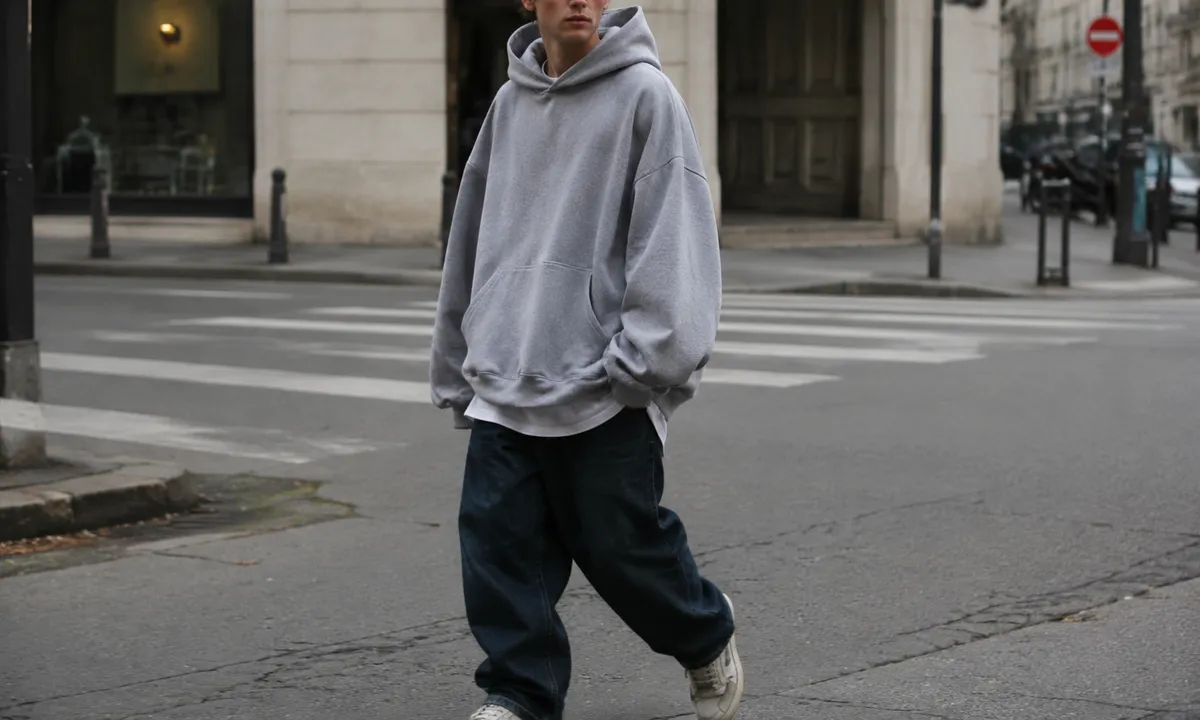
Good oversized styling is not formless. It creates deliberate tension. A coat that is enormous through the body reads as intentional when the trousers underneath are slim and clean, because the contrast between the two parts is doing visual work. The eye reads a structure even if that structure is loose. The same enormous coat over wide-leg trousers and an equally boxy shirt produces a silhouette with no shape at all, just a column of fabric that absorbs the person wearing it.
Fabrication matters just as much. A stiff, heavy cotton oxford that has been sized up drapes with a crispness that gives the excess fabric somewhere to go. The same extra inches in a limp jersey just wrinkle and sag around the torso. The oversized silhouettes that consistently photograph well are almost always in fabrics that hold a shape: dense canvas, structured wool, substantial denim, washed poplin that has enough body to fall cleanly.
Length ratios are the third piece. An oversized top worn over a shorter bottom shows leg. An oversized top tucked loosely into a higher-waist trouser creates a break at the waist. Both of those create a readable proportion. An oversized top worn over a low-rise wide-leg pant creates a rectangle from armpit to ankle. Rectangles are rarely the goal.
What Sizing Up Actually Does to a Body
Clothes that are too large in the wrong places do something specific and unflattering. They relocate visual mass. A shirt with a shoulder seam that falls three inches past the actual shoulder widens the torso in a way that reads as soft rather than relaxed, because the garment is now hinting at a body shape that is broader and lower than the real one. The eye fills in the gap between where the fabric says the shoulder is and where it actually sits, and the inference is unfavorable.
This is especially legible around the waist and hip. Volume in those areas with no counterpoint reads as bulk. Deliberately shaped volume, like a boxy jacket that has structure through the chest and then flares slightly, reads as architecture. The difference between the two is not about how large the garment is. It is about where the garment has been designed to put that largeness.
A useful comparison: a size-up in a shirt from a brand that cut the garment with that extra room in mind versus a shirt that is simply a larger version of a fitted silhouette. The first has seam placement, collar stand, and sleeve pitch calibrated for a looser drape. The second has all of those details in the wrong place for the size. They look completely different on a body even at identical measurements.
The Casualness Fallacy
Part of what drives the oversized assumption is a specific reading of casualness: that loose clothes signal ease, and ease signals confidence. There is something to this as a general cultural reading. But it runs into a problem when the looseness is unintentional or visually incoherent, because the signal flips. Instead of ease, the message becomes that someone grabbed whatever was available and threw it on. That is not confidence. It is disengagement, and most observers can tell the difference even if they could not explain how.
Truly relaxed dressing, the kind that actually reads as cool, requires as much thought as tailored dressing. Often more, because the structure that carries a more fitted silhouette is missing, and something else has to substitute for it. That something else is always intentional: an interesting texture, a deliberate color block, a hem length chosen for a reason, a piece with real weight and quality that earns the looseness it occupies.
The Brands That Understood This Early
Certain Japanese designers spent decades making oversized silhouettes that looked genuinely extraordinary, and the reason is almost always traceable to material and construction rather than size alone. Garments cut from heavyweight, densely woven fabrics that fell in specific ways because of the fiber content and the weave. Proportions that were unusual but internally consistent, so that if the top was enormous, the bottom responded. Pattern cutting that moved seams to create visual lines even within a shapeless silhouette.
The same logic applies to the workwear-influenced American brands that have produced baggy, boxy clothes for a long time, not as a trend but as a function of the garment’s original purpose. A chore coat cut loose enough to layer over a sweatshirt looks the way it does because it was designed to fit a working body in motion. That utility creates a visual logic. A boxy cropped tee in a flimsy poly-cotton blend is borrowing the aesthetic without any of the structural reasoning, and it tends to show.
When Oversized Genuinely Earns It
None of this means oversized is a failure mode. The argument here is narrow: that size alone does not produce the effect. When oversized works, it is because someone made real choices. A coat with extreme volume in a boiled wool so thick it holds a shape independent of the body inside it. A wide oxford shirt in a 120-gram cotton that drapes clean when untucked, with just enough collar roll to look lived-in. A boxy linen trouser in the summer, where the weight and weave breathe, where the leg width is counterbalanced by a fitted top.
These are specific decisions about specific materials and specific proportions. They are not the product of simply going up two sizes. The person who grabs a medium when they usually wear a small is not doing the same thing as the person who spent time thinking about how the shoulder falls and what goes under it.
A Closet Full of the Wrong Reading
The practical consequence of the myth is a particular kind of wardrobe failure that is extremely common: garments that were purchased because they photographed well on a model, worn differently on a non-model body, worn with other oversized pieces because that is what the rest of the wardrobe contains, and then never quite worn again because something about the combination just looks off and no one can identify why. The reason is usually this: the size was the only thing chosen deliberately. Everything else, the proportion, the material, the combination, was left to chance.
A single well-chosen oversized piece in a wardrobe of otherwise fitted clothes tends to look exceptional. A wardrobe built on the premise that loose is always better tends to look like laundry day.